
Kiến Thức Hay
At What Speeds Do Moderate Risks Usually Occur? Answered
Th9
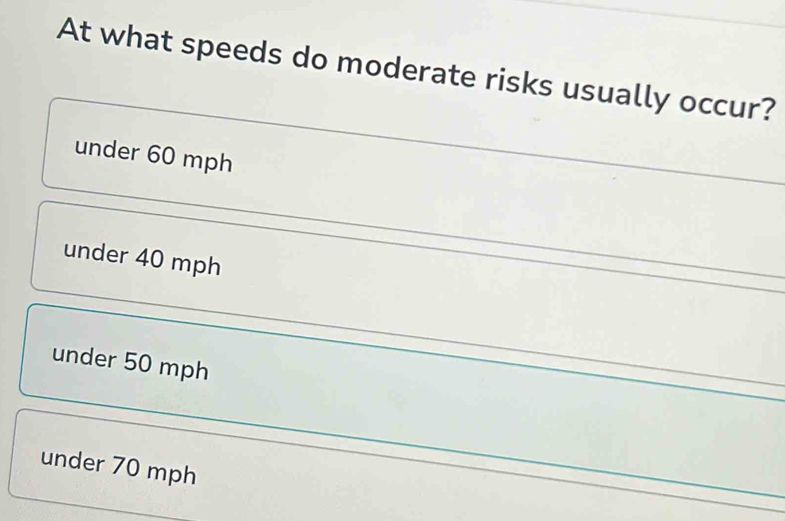
At what speeds do moderate risks usually occur? This is a common question in driver education and road safety courses. Here are the answer choices:
- A. Under 60 mph
- B. Under 40 mph
- C. Under 50 mph
- D. Under 70 mph
The correct answer is C. Under 50 mph. Moderate driving risks — situations that could become dangerous but still allow a trained driver time to react — typically develop at speeds below 50 mph. This speed range is common on urban roads, suburban streets, and two-lane highways where hazards like intersections, pedestrians, and merging traffic frequently appear.
Why Under 50 mph Is the Correct Threshold
Moderate risks sit between low-risk and high-risk driving situations in the risk classification system taught in most defensive driving programs. At speeds under 50 mph, a driver faces hazards that require active scanning and decision-making but generally still allow enough stopping distance and reaction time to avoid a collision — provided the driver stays alert.
Consider what happens on a typical city street posted at 35–45 mph. A car may pull out from a side street, a traffic light may turn yellow, or a cyclist may drift into the lane. These events are not rare, but they are also not instantly catastrophic at moderate speeds because physics works in the driver’s favor: stopping distance grows with the square of speed, so a car traveling at 45 mph needs roughly 200 feet to stop on dry pavement, while the same car at 65 mph needs about 340 feet. The shorter stopping distances below 50 mph give drivers a realistic window to respond to moderate hazards.
Road design reinforces this boundary. Streets engineered for speeds under 50 mph tend to include intersections controlled by signals, marked crosswalks, and turn lanes — all features that introduce frequent but manageable conflicts. Once speeds exceed that range, roads shift toward highway-style design with fewer conflict points but much higher consequences per incident.
Why the Other Choices Are Incorrect
Under 40 mph (Choice B) is the most tempting wrong answer. Speeds below 40 mph do involve risks, but those risks lean toward the low end of the scale. At 25–35 mph — typical residential and school-zone speeds — hazards like parked-car door openings or children crossing a street are present, yet stopping distances are short and crash severity is statistically lower. Labeling everything under 40 mph as “moderate risk” would exclude the 40–49 mph zone where risk meaningfully increases due to heavier traffic flow and longer braking distances.
Under 60 mph (Choice A) stretches the moderate-risk zone too high. Once a vehicle reaches 55–60 mph, it enters highway and freeway conditions where risks shift from moderate to high. Closing speeds between vehicles are greater, reaction windows shrink, and the energy involved in any collision rises sharply. Defensive driving curricula typically classify speeds above 50 mph as the beginning of the high-risk range.
Under 70 mph (Choice D) covers nearly all legal driving speeds in the United States and would blur the line between moderate and high risk entirely. At 65–70 mph, a rear-end collision or lane-change error can be fatal. Including this range under “moderate risk” contradicts the purpose of the classification, which is to help new drivers understand that danger escalates with speed.
How Speed, Stopping Distance, and Risk Connect
Understanding why 50 mph serves as the dividing line becomes easier when you look at the physics. Stopping distance has two parts: reaction distance (how far you travel while your brain processes the hazard) and braking distance (how far you travel after applying the brakes). Both grow as speed increases, but braking distance grows much faster because it depends on the square of velocity.
At 30 mph a typical total stopping distance is about 90 feet. At 50 mph it nearly triples to roughly 250 feet. At 60 mph it jumps to around 305 feet. That steep curve between 40 and 60 mph is exactly where risk transitions from moderate to high. The 50 mph mark sits at the inflection point — fast enough that hazards require serious attention, yet slow enough that a prepared driver can usually stop or steer away in time.
This is also why speed limits on urban arterials rarely exceed 45–50 mph. Traffic engineers set those limits partly based on the density of conflict points and partly on the stopping distances they expect drivers to need. When you see a speed limit near 50 mph, you can assume the road was designed around the idea that moderate risks are present and manageable at that pace.
Quick Tip to Remember the Answer
Think of 50 as the midpoint on a 0–100 mph mental scale. “Moderate” means “middle,” and 50 mph sits right in the middle. Below that boundary, risks exist but remain controllable with proper attention. Above it, you cross into high-risk territory where mistakes become far more costly. Whenever a test question asks about moderate risk and speed, look for the middle-range value among the choices — that will almost always point you to the right answer.
