
Kiến Thức Hay
what does a head frame do? Correct mining answer
Th9
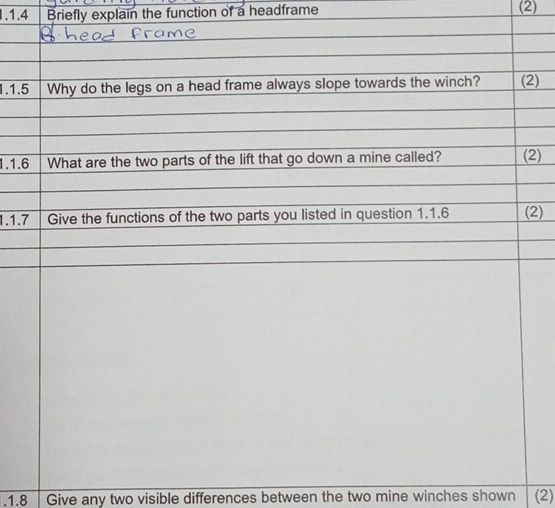
Question: 1.1.4 Briefly explain the function of a headframe. (2)
1.1.5 Why do the legs on a head frame always slope towards the winch? (2)
1.1.6 What are the two parts of the lift that go down a mine called? (2)
1.1.7 Give the functions of the two parts you listed in question 1.1.6. (2)
1.1.8 Give any two visible differences between the two mine winches shown. (2)
The correct answer is: A headframe supports the hoisting equipment above a mine shaft; its legs slope toward the winch for stability; the two lift parts are the cage and the skip; the cage carries miners, while the skip carries materials; visible winch differences may include drum size, motor type, brake design, or safety features. A headframe is the tall structure above a mine shaft that helps the hoist lift and lower loads safely. This directly answers what does a head frame do: it supports the system that moves people and materials in and out of the mine.
Why the correct answer is accurate
A headframe works like a strong tower over a mine shaft. Its main job is to support the hoisting equipment, especially the wheels, cables, and lifting system that move loads up and down the shaft. Without this structure, the cables would not be held in the right position above the shaft.
The legs of the headframe slope toward the winch because the winch pulls with great force. If the legs were straight or leaning the wrong way, the pulling force could make the structure less stable. Sloping the legs toward the winch helps the headframe resist that pull and stay balanced.
The two parts of the lift are the cage and the skip. The cage is like a lift for people: it carries miners safely into and out of the mine. The skip is more like a container: it carries mined rock, ore, or other materials. A simple way to see the difference is this: people use the cage; materials use the skip.
For the winches, the answer allows visible differences because the question asks for “any two.” Valid answers include drum size, motor type, brake system design, and visible safety features. These are acceptable because they can be seen or compared from the shown winches.
Why the other possible answers would be incomplete or wrong
The common mistake is to say that the headframe itself “digs the mine” or “pulls the miners up.” That is not precise. The headframe does not dig, and it is not the winch. It supports the hoisting equipment that does the lifting.
Another easy mix-up is between the cage and the skip. If a learner writes that the skip carries miners, the answer is wrong because the skip is mainly for materials. If they write that the cage carries ore, that is also usually wrong in this school-level mining context because the cage is mainly for people.
For the sloping legs question, “because it looks stronger” is too vague. The better answer must mention stability or resisting the pull from the winch. The direction matters because the force comes from the winch side.
For the winch comparison, answers must be visible differences. For example, saying “one is more expensive” would not be a good answer unless the picture or question gives that information. A visible feature, such as a larger drum or different brake arrangement, is safer and more accurate.
Useful context: how the headframe, winch, cage, and skip work together
The headframe, winch, cage, and skip form one lifting system. The winch winds and unwinds the cable. The cable passes over the headframe equipment. The cage or skip is attached to the lifting system and moves inside the mine shaft.
This is why the answer to what does a head frame do is not only “it is a tower.” Its real function is structural support. It holds the lifting system in the correct place so that people and materials can move safely between the surface and the underground mine.
Memory tip for similar questions
Remember: headframe = support, winch = pull, cage = people, skip = materials. This four-word pattern helps you answer most basic mining-structure questions quickly.
If the question asks why the legs slope, think of the winch pulling hard on the structure. The legs lean toward that pull to make the headframe stable. If the question asks for visible winch differences, choose features you can actually see, such as drum size, motor shape, brake design, or safety guards.
