
Kiến Thức Hay
.375 as a fraction: Correct answer with simple steps
Th9
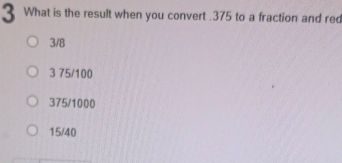
Question: What is the result when you convert .375 to a fraction and reduce it?
A. 3/8
B. 3 75/100
C. 375/1000
D. 15/40
The correct answer is A. 3/8. The decimal .375 as a fraction first becomes 375/1000, then it reduces to 3/8 by dividing the top and bottom by 125.
Why 3/8 is the correct answer
.375 as a fraction means “375 thousandths,” because the 5 is in the thousandths place. So the first fraction is 375/1000. This is correct, but it is not reduced yet.
To reduce 375/1000, divide both numbers by the same largest useful number. Both 375 and 1000 can be divided by 125:
375 ÷ 125 = 3
1000 ÷ 125 = 8
So 375/1000 = 3/8. This works because dividing the numerator and denominator by the same number does not change the value of the fraction. It only writes the fraction in a simpler form.
Why the other answer choices are not correct
B. 3 75/100 is not correct because .375 is less than 1. A mixed number like 3 75/100 is more than 3, so it is much too large.
C. 375/1000 is close and is the easiest choice to confuse with the correct answer. It correctly shows the decimal as a fraction, but the question asks to convert and reduce it. Since 375/1000 can still be simplified to 3/8, it is not the final reduced answer.
D. 15/40 has the same value as 3/8 because 15/40 reduces by 5 to 3/8. However, it is not reduced, so it is not the best answer when the question asks for the reduced fraction.
Quick way to remember this type of question
Count the decimal places first. Three decimal places means thousandths, so .375 becomes 375/1000. Then reduce the fraction.
A fast memory trick: common eighths often appear as decimals. 1/8 = .125, 2/8 = .250, and 3/8 = .375. So when you see .375, think “three eighths.”
