
Kiến Thức Hay
Why are a 12 ounce hard seltzer and 1.5 ounces of liquor both standard drinks? Answer
Th9
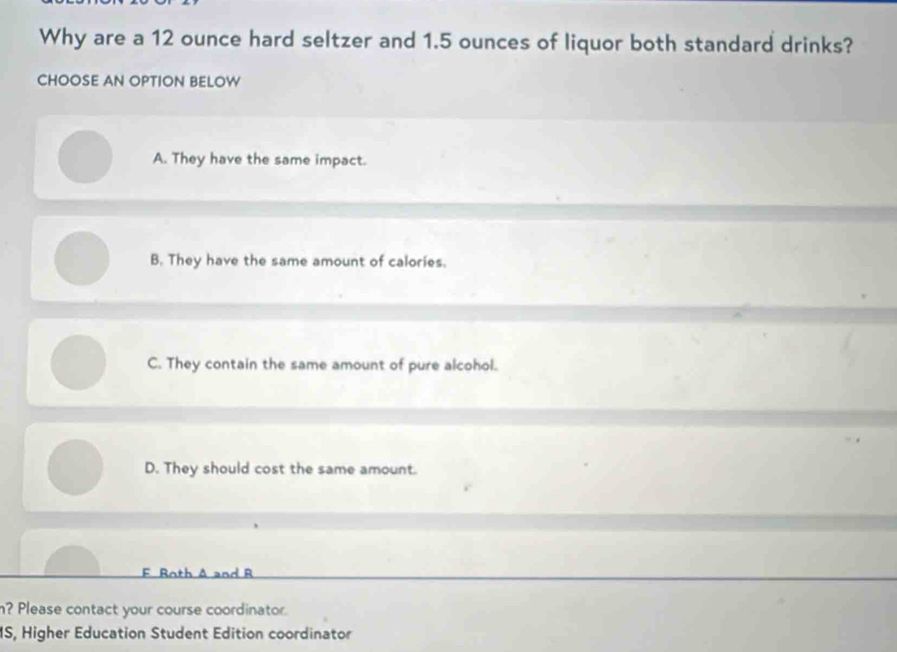
Why are a 12 ounce hard seltzer and 1.5 ounces of liquor both standard drinks?
CHOOSE AN OPTION BELOW
A. They have the same impact.
B. They have the same amount of calories.
C. They contain the same amount of pure alcohol.
D. They should cost the same amount.
F. Both A and R
? Please contact your course coordinator.
1S, Higher Education Student Edition coordinator
The correct answer is C. They contain the same amount of pure alcohol. A 12 ounce hard seltzer and 1.5 ounces of liquor can both count as standard drinks because the “standard drink” idea is based on the amount of pure alcohol, not the container size, calories, price, or taste.
Why answer C is correct
A standard drink is measured by how much pure alcohol it contains. Different drinks can look very different in size, but still contain about the same amount of alcohol. That is why a small pour of liquor can be equal to a full can of hard seltzer.
The key idea is alcohol concentration. Liquor is much stronger than hard seltzer, so it takes fewer ounces of liquor to contain the same amount of alcohol. Hard seltzer is weaker, so the serving size is larger. In common U.S. alcohol education, a standard drink contains about 0.6 fluid ounces of pure alcohol. A 12 ounce hard seltzer at around 5% alcohol by volume and 1.5 ounces of 40% liquor are treated as similar standard drink amounts because each contains about that amount of pure alcohol.
This answers why are a 12 ounce hard seltzer and 1.5 ounces of liquor both standard drinks? clearly: the drinks are not equal because they look the same. They are equal because their alcohol content is roughly the same.
Why the other options are not correct
A. They have the same impact is the easiest tempting answer, but it is not the best answer. Two standard drinks contain the same amount of pure alcohol, yet their impact can vary by body weight, food eaten, drinking speed, medications, tiredness, and tolerance. The amount of alcohol is the standard measure; the effect on a person is not always identical.
B. They have the same amount of calories is incorrect. Calories depend on ingredients, sugar, flavoring, mixers, and alcohol content. A hard seltzer and a shot of liquor do not have to contain the same calories to be counted as standard drinks.
D. They should cost the same amount is incorrect. Price has nothing to do with the definition of a standard drink. Cost depends on brand, location, packaging, taxes, and where it is sold.
F. Both A and R is not supported by the choices as written. The question asks why both drinks are standard drinks, and the direct scientific reason is option C: they contain the same amount of pure alcohol.
Extra context: serving size and alcohol strength
Pure alcohol is the hidden number behind standard drink questions. A large container is not always “more alcohol,” and a small container is not always “less alcohol.” What matters is the combination of serving size and alcohol percentage.
For example, liquor often has a much higher alcohol by volume than hard seltzer. So 1.5 ounces of liquor can carry a similar alcohol load to 12 ounces of a lower-strength drink. This is why alcohol education uses standard drink sizes: it gives people a simple way to compare drinks that look very different.
Quick way to remember this type of question
When a question asks why two different alcoholic drinks are both standard drinks, look for the answer about pure alcohol. Ignore answers about price, calories, flavor, or container size unless the question specifically asks about those things.
A simple memory rule: standard drink = standard amount of alcohol. That rule points directly to answer C for why are a 12 ounce hard seltzer and 1.5 ounces of liquor both standard drinks?
