
Kiến Thức Hay
Explain How Glaspell Uses Irony to Illustrate Mistreatment
Th9
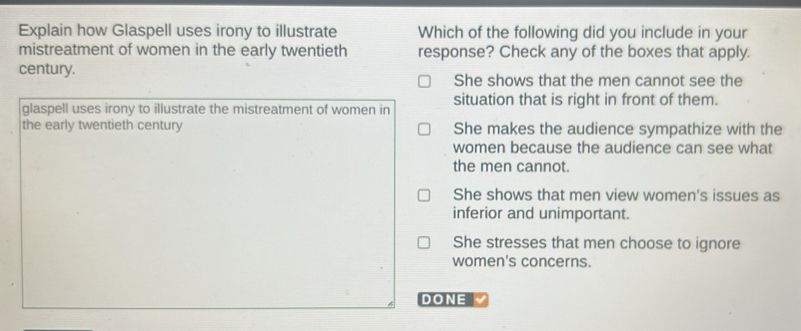
Question: Explain how Glaspell uses irony to illustrate the mistreatment of women in the early twentieth century. Which of the following did you include in your response? Check any of the boxes that apply.
- A. She shows that the men cannot see the situation that is right in front of them.
- B. She makes the audience sympathize with the women because the audience can see what the men cannot.
- C. She shows that men view women’s issues as inferior and unimportant.
- D. She stresses that men choose to ignore women’s concerns.
The correct answers are A, B, C, and D. In Susan Glaspell’s work, irony exposes how the men overlook important evidence while the women understand its meaning. This directly supports the idea of how Glaspell uses irony to illustrate mistreatment of women in the early twentieth century.
Why all four answers are correct
All four statements describe a different effect of Glaspell’s irony. The central irony is that the men believe they are intelligent investigators, yet they fail to understand the clues placed directly before them. The women, whom the men treat as unimportant, notice the meaning of those clues.
This contrast makes the audience sympathize with the women. Readers can recognize the importance of details that the male characters dismiss. The audience therefore sees the unfairness of the men’s behavior more clearly than the men see it themselves.
The men’s attitude also reflects the treatment of women during the early twentieth century. Women’s thoughts, household experiences, and emotional concerns are treated as inferior rather than as valuable sources of knowledge. The men do not merely overlook the women’s concerns by accident; their assumptions lead them to ignore those concerns.
How Glaspell’s irony creates this meaning
Glaspell uses a gap between appearance and reality. On the surface, the men seem to have authority because they represent the law and control the investigation. In reality, the women understand the situation more accurately. That reversal is ironic because the people considered weak or incapable become the ones who recognize the truth.
Small domestic details are especially important. The men see ordinary household matters and dismiss them as insignificant. The women understand that these details reveal the woman’s isolation and suffering. The same evidence is visible to everyone, but only the women read it carefully.
This method does more than criticize individual characters. It shows how social prejudice can prevent people from recognizing another person’s pain. The men’s blindness is therefore both literal within the investigation and symbolic of a wider failure to respect women’s experiences.
Why the other choices are not incorrect
Unlike a question with only one answer, this item asks readers to check every statement that applies. Each option identifies a valid part of Glaspell’s use of irony.
- A is correct because the men overlook the meaning of evidence that is directly in front of them.
- B is correct because the audience understands the women’s perspective and sees why their observations matter.
- C is correct because the men treat women’s concerns and domestic knowledge as inferior or unimportant.
- D is correct because the men’s dismissive attitude causes them to disregard what women are trying to communicate.
The easiest option to miss is D. The men may not always openly announce that they want to ignore women, but their jokes, assumptions, and refusal to listen produce exactly that result. Their behavior shows deliberate disregard, even when it appears as casual mockery or confidence in their own judgment.
Memory tip for similar questions
Look for a reversal between what characters believe and what the audience knows. If men claim authority but miss the truth, while women notice details that are dismissed, the irony supports all four ideas: male blindness, audience sympathy, the devaluation of women’s issues, and the ignoring of women’s concerns.
A useful shortcut is to ask: Who sees the evidence, who dismisses it, and who understands its meaning? In Glaspell’s treatment of gender inequality, the answer to those three questions reveals how the irony works.
