
Kiến Thức Hay
What Caused Baby David’s Death? Correct Answer Explained
Th9
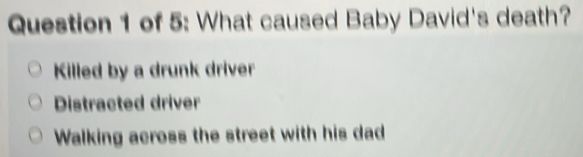
Here is the question: What caused Baby David’s death?
- A. Killed by a drunk driver
- B. Distracted driver
- C. Walking across the street with his dad
The correct answer is A. Killed by a drunk driver. Baby David lost his life because a driver who was under the influence of alcohol struck him. This was not an accident caused by mere distraction or by the simple act of crossing a street — it was the direct result of someone choosing to drive drunk.
Why a Drunk Driver Is the Correct Answer
Baby David was killed when a drunk driver hit him. Drunk driving means operating a vehicle with a blood alcohol concentration above the legal limit, which severely impairs reaction time, judgment, and motor control. A drunk driver is far more likely to run red lights, swerve into pedestrians, or fail to stop in time. In David’s case, the impaired driver was the direct and primary cause of his death — not road conditions, not a vehicle malfunction, and not anything David or his family did wrong.
This distinction matters because the question asks specifically about the cause of death. The cause is the factor that, if removed, would have prevented the tragedy. Had the driver been sober, the collision would likely never have occurred. That is why “killed by a drunk driver” answers the question precisely.
Why the Other Options Are Incorrect
Option B — Distracted driver is the most tempting wrong answer because distracted driving (texting, eating, adjusting a GPS) also causes fatal crashes. However, distraction and intoxication are different impairments. The information provided about David’s case specifically identifies alcohol-impaired driving, not distraction, as the cause. Choosing this option would misidentify the type of negligence involved.
Option C — Walking across the street with his dad describes a circumstance, not a cause. David and his father were pedestrians doing something perfectly ordinary and legal. Crossing a street does not cause a death; being struck by an impaired driver does. Blaming the victim’s location shifts responsibility away from the actual cause, which is the drunk driver’s decision to get behind the wheel while intoxicated. This option is less likely to trick careful readers, but it can catch those who confuse “where it happened” with “why it happened.”
The Broader Reality of Drunk Driving Fatalities
Cases like Baby David’s are tragically common. In the United States alone, the National Highway Traffic Safety Administration (NHTSA) reports that roughly 13,000 people die each year in alcohol-impaired driving crashes — averaging about 37 deaths per day. Children and pedestrians are among the most vulnerable victims because they have no protective barrier against a multi-ton vehicle. Drunk driving is not an “accident” in the usual sense; it begins with a deliberate choice to drink and then drive, which is why it carries criminal penalties including manslaughter or vehicular homicide charges in most jurisdictions.
Stories like David’s are often shared in awareness campaigns and educational quizzes precisely because they put a human face on statistics. Knowing what caused Baby David’s death reinforces why zero-tolerance attitudes toward impaired driving exist.
Quick Tip for Similar Questions
When a question asks “what caused” an event, look for the factor that directly produced the outcome — not the setting, not the background activity, and not a loosely related concept. A useful test: ask yourself, “If I remove this factor, does the tragedy still happen?” The option whose removal prevents the event is the true cause. In this case, remove the drunk driver and David likely walks safely across the street with his dad. That single-factor test points straight to Option A every time.
