
Kiến Thức Hay
What document explains your rights and responsibilities? Answer
Th8
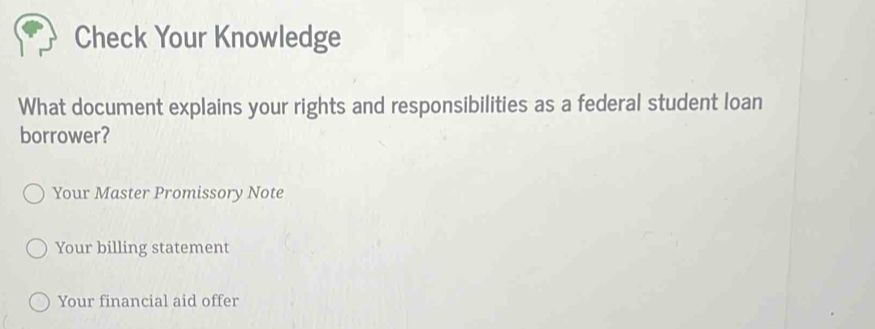
Question: What document explains your rights and responsibilities as a federal student loan borrower?
- A. Your Master Promissory Note
- B. Your billing statement
- C. Your financial aid offer
The correct answer is A. Your Master Promissory Note. The Master Promissory Note explains the borrower’s rights and responsibilities because it is the legal agreement for a federal student loan. It tells you what you promise to do, including repaying the loan and following the loan terms.
Why Your Master Promissory Note is the correct answer
Your Master Promissory Note, often called an MPN, is the main document that explains your obligations when you borrow a federal student loan. It is a promise to repay the loan under the stated terms, so it includes the rules a borrower needs to understand before accepting the debt.
The key idea is simple: a federal student loan is borrowed money, not a grant or scholarship. Because you must pay it back, the loan needs a formal document that explains what you are agreeing to. The Master Promissory Note covers important borrower responsibilities such as repayment, interest, loan terms, and what happens if payments are not made as required.
That is why the answer to “what document explains your rights and responsibilities as a federal student loan borrower?” is not a general school notice or a payment reminder. It is the document connected directly to the legal promise to repay the federal loan.
Why the other options are not correct
Your billing statement is not the correct answer because it mainly shows payment information. For example, it may show how much is due, when the payment is due, or account details. It helps you manage repayment, but it does not serve as the main document explaining all borrower rights and responsibilities.
Your financial aid offer is also not the correct answer. A financial aid offer tells you what aid a school is offering, such as grants, scholarships, work-study, or loans. It helps you compare costs and aid options, but it is not the legal loan agreement that explains the full terms of borrowing.
The easiest wrong choice to confuse with the correct answer is the financial aid offer. Students may choose it because it appears before they borrow and includes loan information. The difference is that the offer lists available aid, while the Master Promissory Note explains the promise and rules tied to actually borrowing the federal student loan.
Helpful context about federal student loan documents
Federal student loan documents do not all have the same purpose. Some documents help you decide whether to borrow, some help you track payments, and some create the official borrowing agreement. The Master Promissory Note belongs to the third group.
A useful way to separate them is by asking what stage of the loan process the document belongs to. A financial aid offer comes before borrowing, a Master Promissory Note is used when agreeing to borrow, and a billing statement comes after borrowing when repayment or account tracking begins.
Quick way to remember the correct answer
Remember “promissory” means promise. If the question asks about your rights and responsibilities as a borrower, look for the document where you make the promise to repay. That points to the Master Promissory Note.
For similar questions, use this shortcut: offer means aid choices, billing statement means payment details, and Master Promissory Note means borrower agreement. So when you see “rights and responsibilities” or “federal student loan borrower,” choose Your Master Promissory Note.
