
Kiến Thức Hay
There are three different types of slings. What determines which type you use? Answer
Th9
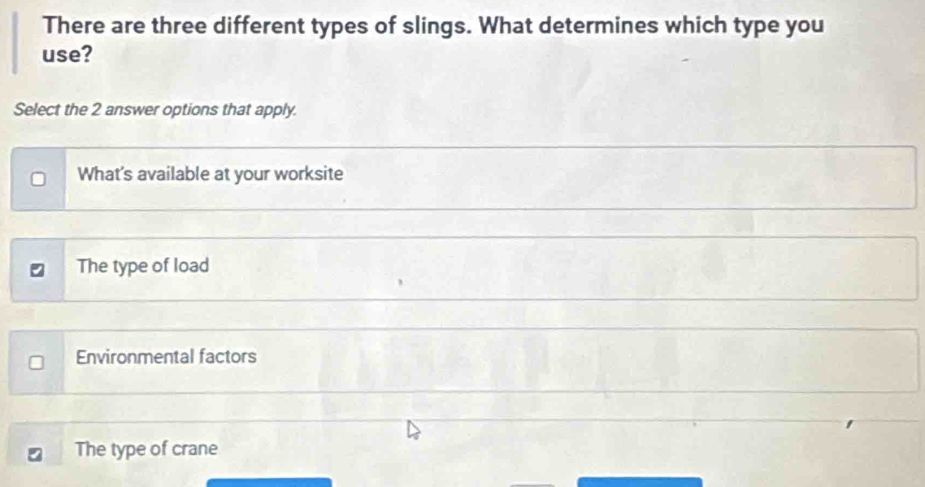
There are three different types of slings. What determines which type you use?
Select the 2 answer options that apply.
A. What’s available at your worksite
B. The type of load
C. Environmental factors
D. The type of crane
The correct answers are B. The type of load and C. Environmental factors. Sling selection depends on what must be lifted and the conditions around the lift. The question “there are three different types of slings. what determines which type you use?” points to safe rigging choices, not convenience or crane type alone.
Why the correct answers are the type of load and environmental factors
Slings are chosen mainly by matching the sling to the load and the lifting environment. A heavy, sharp-edged, hot, fragile, or oddly shaped load may need a different sling than a smooth, balanced load.
The type of load matters because the sling must support the load safely without breaking, slipping, crushing the material, or being damaged by the load’s edges. For example, a load with sharp corners may damage some synthetic slings unless proper protection is used. A very heavy load may require a sling with a higher rated capacity.
Environmental factors also matter because heat, chemicals, moisture, abrasive surfaces, and outdoor conditions can affect sling performance. A sling that works well in a clean indoor area may not be the best choice near high heat or corrosive substances. The safe choice is the sling that can handle both the load and the surroundings.
Why the other answer options are not correct
A. What’s available at your worksite is not a proper safety basis for choosing a sling. Availability may affect what equipment is nearby, but it does not prove the sling is suitable. If the only available sling is not rated or appropriate for the load, it should not be used.
D. The type of crane can affect the lifting setup, but it is not the main factor that determines the sling type in this question. The crane provides the lifting force; the sling directly contacts and supports the load. That is why load characteristics and environmental conditions are more important for sling selection.
The easiest wrong choice is A, because people may think they should use whatever is already at the worksite. That is unsafe reasoning. Rigging decisions must start with suitability, not convenience.
Quick way to remember this type of question
Use the simple rule: load first, environment second. Ask two questions before choosing a sling: “What am I lifting?” and “Where am I lifting it?” If an answer choice is about convenience, such as what is available, it is usually not the safest deciding factor.
For similar rigging questions, look for options linked to weight, shape, edges, temperature, chemicals, and work conditions. These directly affect whether a sling can lift safely.
