
Kiến Thức Hay
Where Can You Contest an Alleged Traffic Violation? Answer
Th8
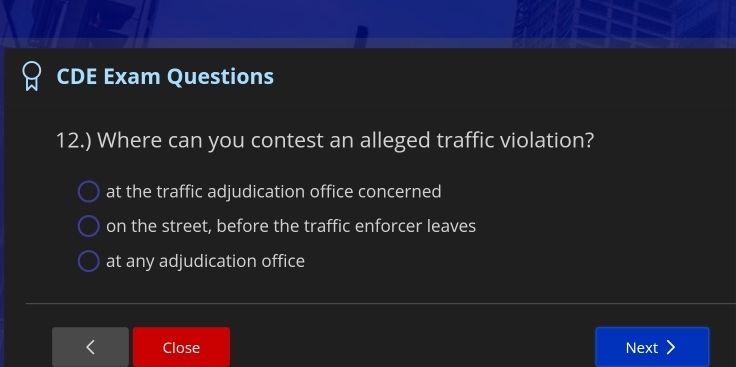
CDE Exam Question: Where can you contest an alleged traffic violation?
- A. At the traffic adjudication office concerned
- B. On the street, before the traffic enforcer leaves
- C. At any adjudication office
The correct answer is A — at the traffic adjudication office concerned. When you receive a traffic citation you believe is unjust, Philippine traffic law directs you to file your contest at the specific adjudication office that has jurisdiction over the violation, not on the spot and not at a random office elsewhere.
Why the Traffic Adjudication Office Concerned Is the Correct Venue
Traffic adjudication in the Philippines follows a jurisdiction-based system. Each traffic adjudication office handles cases arising within its defined area of responsibility — typically aligned with the city, municipality, or agency that issued the ticket. Republic Act No. 4136 (the Land Transportation and Traffic Code) and local traffic ordinances establish that a motorist who wishes to dispute a citation must appear before the office that actually issued it or has authority over the location where the alleged violation occurred.
This structure exists for practical and legal reasons. The enforcer’s report, supporting evidence such as photographs or CCTV footage, and witness availability are all tied to that specific office. Routing the contest there ensures the hearing body can access all relevant records without delay. It also prevents forum shopping — the practice of choosing a different office in hopes of a more favorable outcome.
Under most local government traffic management systems (for example, the MMDA in Metro Manila or the LTO for national highways), the citation itself states which office to report to and the deadline for doing so, usually within a set number of days.
Why the Other Options Are Wrong
Option B — “On the street, before the traffic enforcer leaves” is the most tempting wrong answer. Many drivers instinctively argue with the enforcer at the scene, but this is not a legally recognized way to contest a violation. An enforcer on the road is performing an executive function — issuing citations — not a judicial or quasi-judicial one. Disputing the ticket on the spot has no legal effect; the citation still stands, and confrontational behavior can even lead to additional charges such as obstruction or resistance to a person in authority.
Option C — “At any adjudication office” sounds partially correct because it at least mentions an adjudication office. However, the word “any” makes it wrong. You cannot walk into an adjudication office in Cebu to contest a ticket issued in Quezon City. Jurisdiction matters. The office must be the one concerned — the one with authority over your specific case. This option is a classic exam trap: it contains familiar correct-sounding language but adds one inaccurate word that changes the meaning entirely.
How the Traffic Adjudication Process Generally Works
After receiving a traffic violation ticket (TVT), a motorist typically has 15 to 30 days — depending on the issuing agency — to settle or contest it. If contesting, the driver goes to the designated adjudication office listed on the ticket, submits a written explanation or counter-affidavit, and attends a hearing. The hearing officer reviews the enforcer’s report alongside the driver’s evidence, then renders a decision: uphold the violation, reduce the penalty, or dismiss the case.
Failing to appear within the deadline does not erase the violation. Instead, unresolved tickets can result in the vehicle being flagged in the LTO database, which blocks registration renewal. For MMDA-issued tickets, unpaid violations accumulate and may be enforced during future stops or impoundment operations.
Quick Tip for Remembering This Answer
Focus on the word “concerned” — it means the specific office that deals with your case. Whenever a CDE exam question asks where can you contest an alleged traffic violation, look for the answer that pairs “adjudication office” with a word indicating jurisdiction (like “concerned” or “proper”). Reject any option suggesting you argue on the road or go to just any office. The rule is simple: right place, right office, right jurisdiction.
