
Kiến Thức Hay
Which Desserts From Around the World Are You Familiar With? Answer
Th9
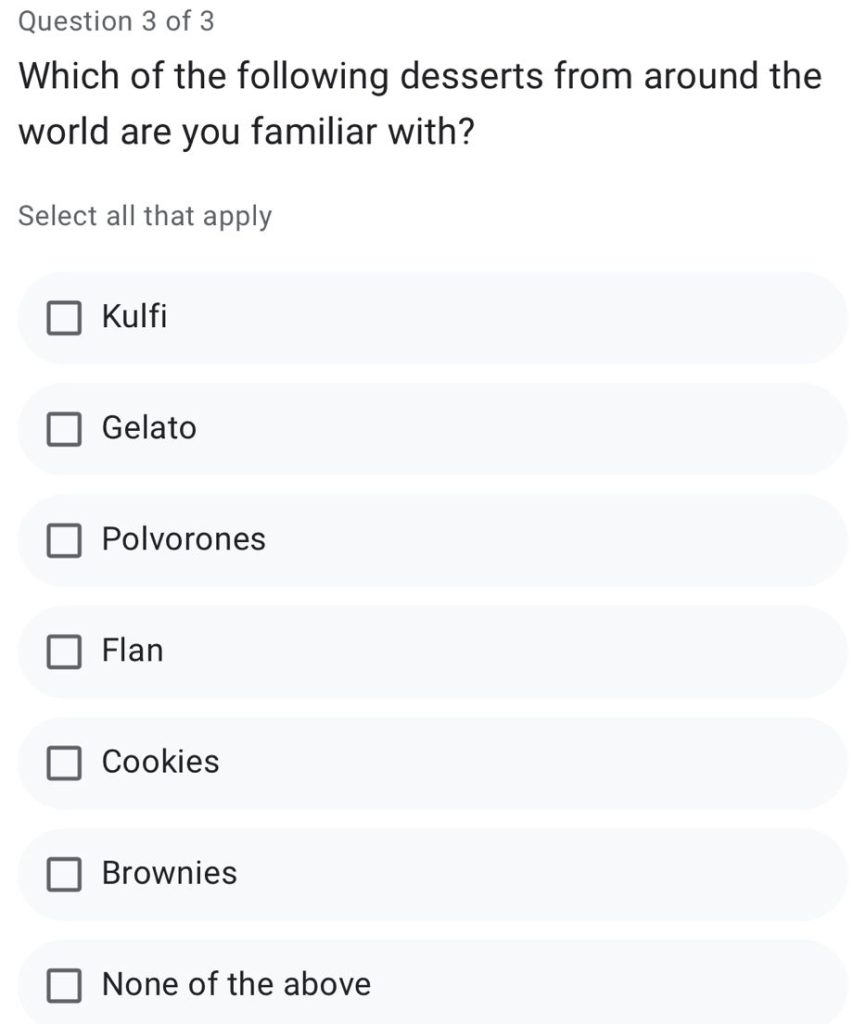
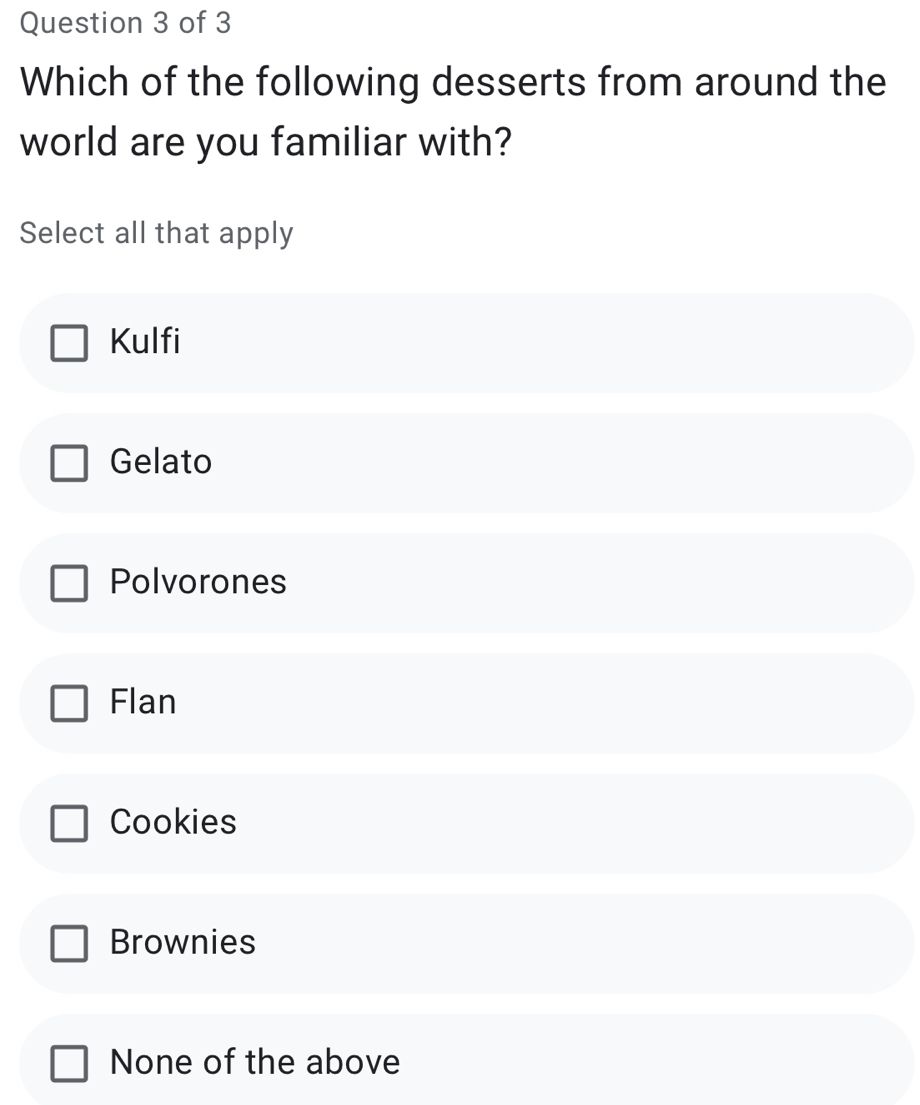
Which of the following desserts from around the world are you familiar with? Select all that apply:
- Kulfi
- Gelato
- Polvorones
- Flan
- Cookies
- Brownies
- None of the above
The correct answer is: Kulfi, Gelato, Polvorones, Flan, Cookies, and Brownies — all six are real desserts from around the world. Each one originates from a distinct culinary tradition, so unless someone has never encountered any of them, “None of the above” would be the only incorrect selection. This question is not a trick — every listed option is a genuine, widely recognized dessert.
Why All Six Desserts Are Valid Answers
Every item on this list belongs to a well-documented dessert tradition. Here is what makes each one authentic:
Kulfi is a frozen dairy dessert from the Indian subcontinent, dating back to the Mughal Empire in the 16th century. Unlike Western ice cream, kulfi is not whipped during freezing, which gives it a denser, creamier texture. Common flavors include cardamom, pistachio, mango, and saffron. It remains hugely popular across India, Pakistan, Bangladesh, and neighboring countries.
Gelato originated in Italy and differs from standard ice cream in important ways: it uses more milk than cream, contains less air (lower overrun), and is served at a slightly warmer temperature. The result is a smoother, more intensely flavored product. Gelato has been part of Italian culture since at least the Renaissance period, and today gelaterias can be found worldwide.
Polvorones are crumbly shortbread-style cookies traditional to Spain, particularly Andalusia, and widely enjoyed across Latin America and the Philippines. The name comes from “polvo,” meaning dust or powder, which describes their delicate, powdery texture. They are especially associated with Christmas celebrations in Spanish-speaking countries.
Flan is a caramel custard dessert with roots in Roman cuisine that evolved through Spanish and French culinary traditions. It consists of a silky egg custard topped with a layer of soft caramel. Variations exist throughout Europe, Latin America, and Southeast Asia — from the French crème caramel to the Filipino leche flan.
Cookies are baked treats most commonly associated with American and European baking. The word itself comes from the Dutch “koekje,” meaning little cake. Chocolate chip cookies, arguably the most iconic variety, were invented by Ruth Graves Wakefield in Massachusetts around 1938. Cookies now span hundreds of varieties across virtually every culture.
Brownies are dense, chocolate-baked squares that originated in the United States in the late 19th century. The earliest known recipe appeared in the 1897 Sears, Roebuck catalog. Brownies occupy a unique space between cake and cookie — fudgy versions lean toward dense chocolate, while cakey versions rise more like a sponge.
Why “None of the Above” Does Not Apply
“None of the above” would only be correct if none of the listed items were real desserts — or if the question specifically asked which ones you personally have tasted and you genuinely had not tried any. Since the question asks which desserts you are familiar with (meaning you recognize or know about them), and all six are well-known worldwide, most respondents would select at least several.
The option most likely to cause confusion is Polvorones. Compared to universally recognized names like cookies or brownies, polvorones are less familiar outside Spanish-speaking communities and the Philippines. Someone unfamiliar with Spanish dessert traditions might skip it, assuming it is not a real dessert or confusing it with something else. However, polvorones are absolutely a legitimate and widely enjoyed treat — just one with a more regional footprint than, say, gelato or flan.
Another potential source of hesitation is Kulfi. People without exposure to South Asian cuisine might not recognize the name. Kulfi is sometimes confused with regular ice cream, but it is a distinct category with its own preparation method and centuries-long history.
A Closer Look at World Dessert Geography
This question highlights something worth noticing: desserts travel across borders, but they carry their origins with them. Kulfi tells the story of Mughal royal kitchens. Gelato reflects Italy’s centuries-old obsession with craft and flavor purity. Polvorones connect Spain’s medieval convents — where nuns often developed pastry recipes — to holiday tables across the Americas. Flan traces a line from ancient Rome through colonial-era kitchens to modern-day restaurants on multiple continents.
Cookies and brownies, while often thought of as generically “American,” also have cross-cultural roots. The Dutch influence on the word “cookie” and the broader European baking tradition behind it remind us that even familiar everyday treats have deeper histories than we assume.
What sets world desserts apart from each other usually comes down to three factors: the base ingredient (dairy, eggs, flour, or fruit), the technique (frozen, baked, steamed, or set), and the cultural occasion (daily snack, festival treat, or formal course). Recognizing these patterns makes it easier to identify unfamiliar desserts when they appear in questions like this one.
Quick Tips for Dessert-Knowledge Questions
When a question asks you to identify desserts from around the world, apply a simple test: does the name sound like it could belong to a specific cuisine? Names ending in “-i” often point to South Asian or Middle Eastern origins (kulfi, jalebi, gulab jamun). Italian desserts frequently end in “-o” or “-to” (gelato, tiramisu, panna cotta). Spanish desserts may end in “-ones” or “-ón” (polvorones, turrón). If the name fits a recognizable linguistic pattern and you have even a vague sense you have heard it before, it is almost certainly a real dessert.
For “select all that apply” formats, default to inclusion rather than exclusion. These questions rarely include fake items — the challenge is recognizing less common ones, not spotting invented names. When in doubt, select it unless you have a strong reason to believe it is fictional.
