
Kiến Thức Hay
how do behavioral economists view people differently? Answer
Th9
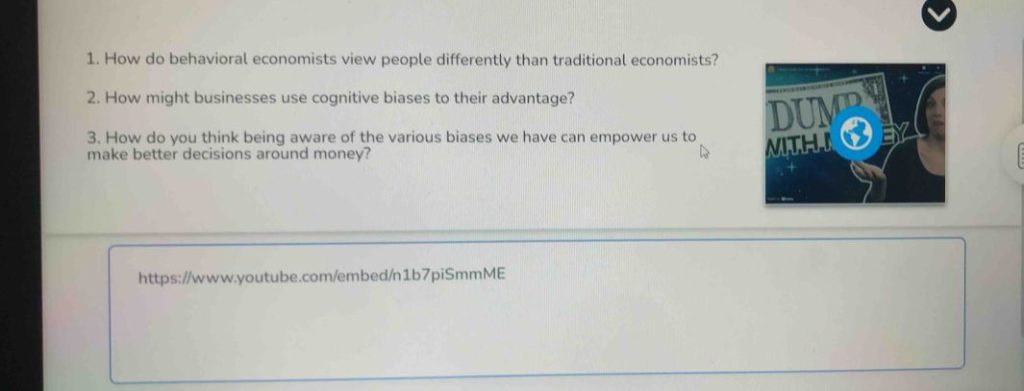
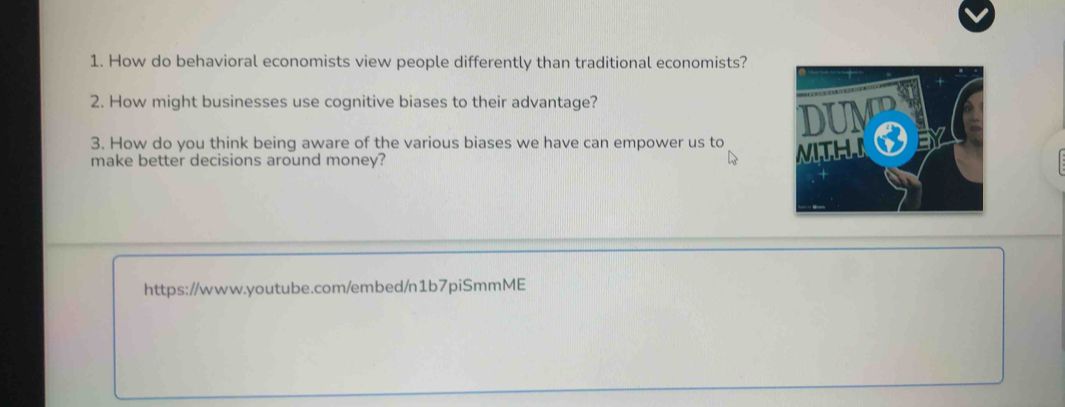
Question: How do behavioral economists view people differently than traditional economists?
2. How might businesses use cognitive biases to their advantage?
3. How do you think being aware of the various biases we have can empower us to make better decisions around money?
No A, B, C, or D answer choices were provided in the original prompt.
The correct answer is: Behavioral economists view people as influenced by emotions, cognitive biases, and social factors, while traditional economists often assume people make rational choices based on information and self-interest. This answers how do behavioral economists view people differently than traditional economists? because it shows the main contrast: real people do not always act like perfect calculators.
Why the answer is correct
Behavioral economists study how people actually make choices, not only how they would choose if they were perfectly rational. A traditional economic model often treats a person as someone who compares costs and benefits carefully, then chooses the option that gives the most personal benefit.
Behavioral economics says that this model is useful but incomplete. People may buy something because it feels urgent, because the first price they saw became an “anchor,” because they fear losing money more than they enjoy gaining the same amount, or because a choice is framed in a persuasive way. For example, a shirt marked down from $100 to $50 can feel like a better deal than the same shirt simply priced at $50, even though the final price is identical.
The key idea is not that people are foolish. The key idea is that human decision-making is limited by attention, emotion, habit, memory, and social pressure. That is why behavioral economists can explain choices that traditional models may struggle to explain.
Why the other possible views would be incomplete or wrong
Since the original prompt did not include A, B, C, or D options, the safest way to compare wrong answers is to examine common incorrect interpretations.
- “People are always rational.” This is closer to the traditional economic assumption, not the behavioral economics view. It ignores bias, emotion, and context.
- “People make choices only to maximize money.” This is incomplete. People also care about fairness, fear, pride, convenience, habits, and how choices are presented.
- “People are completely irrational.” This is the easiest trap. Behavioral economists do not usually mean people act randomly all the time. They mean people often make predictable mistakes.
- “Businesses cannot use cognitive biases.” This is wrong. Businesses often use anchoring, scarcity, default options, and framing to influence buying decisions.
The most confusing wrong idea is “people are completely irrational.” Behavioral economics is stronger than that. It says our mistakes often follow patterns. Because the patterns can be studied, they can also be predicted and reduced.
How businesses can use cognitive biases
Cognitive biases can help businesses shape how customers notice, compare, and choose products. A common example is anchoring: a company may show an expensive product first so that the next product looks more affordable.
Scarcity is another example. A message such as “only 2 left” can create urgency, even when the buyer has not fully compared alternatives. Framing also matters. “Save $20” may feel more attractive than “pay $80,” although both can describe the same purchase. These methods work because customers often respond quickly to signals, not only to careful calculation.
This does not mean every use is fair. Businesses can use these insights responsibly by making choices clearer, or unfairly by pushing people toward purchases they do not need.
How awareness of bias can improve money decisions
Knowing about bias gives people a pause button before they spend, borrow, or invest. If someone recognizes loss aversion, they may understand why selling a losing investment feels painful, even when changing strategy might be sensible.
Awareness also helps with budgeting. A person who knows about framing may compare the real final cost instead of reacting to phrases like “small monthly payment.” Someone who knows about scarcity may wait before buying a discounted item and ask, “Would I still want this tomorrow?” That simple delay can prevent emotional spending.
The practical benefit is control. Biases do not disappear, but they become easier to notice. Once noticed, they can be checked with rules, lists, waiting periods, or advice from a financially knowledgeable person.
Quick way to remember this question
Remember the contrast this way: traditional economics often starts with the rational chooser; behavioral economics starts with the human chooser. If a question asks how do behavioral economists view people differently than traditional economists, look for an answer mentioning emotions, bias, social influence, or imperfect decision-making.
A fast test is to ask: “Does this answer describe people like perfect calculators or like real humans?” Behavioral economics chooses the second one.
