
Kiến Thức Hay
Which of the following financial institutions typically have the highest fees? Answer
Th9
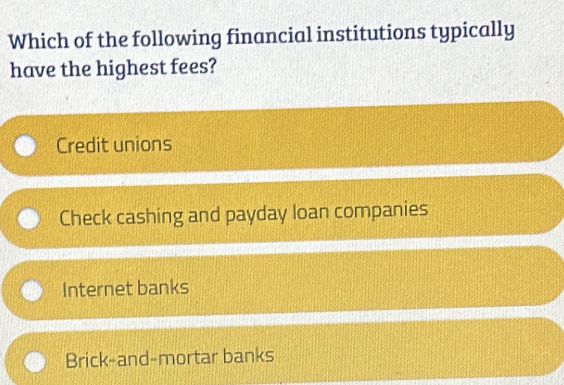
Which of the following financial institutions typically have the highest fees?
A. Credit unions
B. Check cashing and payday loan companies
C. Internet banks
D. Brick-and-mortar banks
The correct answer is B. Check cashing and payday loan companies. These businesses usually charge higher fees because they often serve people who need quick cash or short-term loans, and their services can come with costly charges compared with banks or credit unions.
Why check cashing and payday loan companies are the correct answer
Check cashing and payday loan companies are usually the most expensive option among the choices because their main services are fee-based and short-term. Instead of helping customers save money over time, they often charge people to cash a paycheck, borrow money until payday, or access cash quickly.
A simple way to understand this is to compare the service to using a regular bank account. If a person has a checking account, they may be able to deposit a paycheck without paying a large separate fee. At a check cashing business, the person may pay a fee just to turn that check into cash. Payday loans can be even more expensive because the borrower pays fees for a very short loan, often due on the next payday.
The key idea is risk and convenience. These companies may serve customers who do not have traditional bank accounts or who need money fast. Because of that, they often charge higher fees than mainstream financial institutions. That is why the answer to which of the following financial institutions typically have the highest fees? is check cashing and payday loan companies.
Why the other choices are not the best answer
Credit unions are not the best answer because they are member-owned financial institutions. They often have lower fees and better rates than many traditional banks because they are designed to serve their members rather than outside shareholders.
Internet banks are also not usually the highest-fee option. Many online banks have fewer physical branches, so they may have lower operating costs. Because of that, they often offer lower fees or better interest rates than some traditional banks.
Brick-and-mortar banks can charge fees, such as monthly maintenance fees, overdraft fees, or ATM fees. This choice can be confusing because many people have seen bank fees in real life. Still, traditional banks usually do not charge as heavily as payday lenders or check cashing companies for short-term cash access.
The easiest trap is choosing brick-and-mortar banks. They are common, and their fees are familiar. But the question asks which institutions typically have the highest fees, not which ones have any fees. Payday loan and check cashing companies are the stronger answer because their business model often depends on charging direct service fees for quick access to money.
Quick way to remember this type of question
Remember the rule: faster cash usually means higher fees. If a financial service offers quick cash, payday loans, or check cashing without a regular bank account, expect it to be more expensive.
For similar questions, sort the choices from most consumer-friendly to most costly. Credit unions and internet banks often lean lower-fee. Traditional banks may fall in the middle. Check cashing and payday loan companies are usually the highest-fee choice.
